AI Search Has Rewritten Insurance Distribution. We Measured What It Did.
Article Summary
This article by Mehul Jain and Sankalp Agarwal, co-founders of Geology, argues that AI answer engines have become an insurance distribution channel that does not behave like search. Drawing on the State of AI Visibility 2026 - BFSI India, which covers 32 categories of Indian financial services, the authors show that a health insurance brand ranking in Google's top ten for 80% of buying questions is named in only 24% of AI answers. Readers will understand why search authority does not transfer to AI answers and what distribution teams can do about it.
By Mehul Jain, Co-founder and CEO, Geology and Sankalp Agarwal, Co-founder and COO, Geology
AI Search Has Rewritten Insurance Distribution. We Measured What It Did.
Findings from the State of AI Visibility 2026 - BFSI India, an index of what AI answers say about Indian financial services.
Insurance distribution in India has always been a question of who owns the moment of choice. Agents owned it, then aggregators took a share of it, then performance marketing bid for it.
Something else owns a growing part of it now, and it does not behave like any of the three. It does not rank, it does not bid, and it does not show a list. It gives a buyer two or three names and a reason.
In our latest report, State of AI Visibility 2026 - BFSI, we found out what it actually says. Across 32 categories of Indian financial services, we asked the questions a buyer asks before they have decided or named a brand. No prompt names a company. We studied which insurers AI engines recommend and what they say about each insurer.
For distribution specifically, four crucial insights have emerged from it.
The intermediary layer got inverted

Figure 1. Search rank no longer predicts the AI answer
The clearest result in health insurance is what happened to the aggregators.
The brand that ranks in Google's top ten for 80% of these buying questions is named in 24% of AI answers. It has the largest content estate in the category by a wide margin, and the most links. On the surface that increasingly matters, it is a minority presence.
Meanwhile, on ChatGPT, the most-cited company website in the category is not a carrier at all. It is a distributor, cited more often than any insurer and behind only the regulator, built on a fraction of the category's authority.
The difference between the two is not spend or scale. It is what they publish. Reading three months of publishing across the category, that distributor changed thousands of URLs and nearly nine in ten of them were comparison and best-of pages, most answering a question about a specific named insurer. The carriers, over the same period, were republishing product pages: for three of them, that was the clear majority of everything they touched.
Distribution advantage in this channel is not accruing to the largest estate. It is accruing to the estate built as answers.
Carriers are being recommended through content they do not own

Figure 2. Recommended through content you do not own
One large insurer in the category is named in 60% of AI answers. Its own website accounts for 0.8% of the sources behind those answers.
That is a real commercial position built almost entirely on other people's comparison content. It is working today. It is also a dependency, not an asset: the brand has no control over the pages producing it, cannot correct them, and will not be told when they change.
Across the whole index, 39% of the companies we track are never named in a single answer in their own category. Not ranked low. Absent. For a distribution team, that is the more useful number, because it says the floor in this channel is zero rather than low.
Search reporting no longer describes this channel
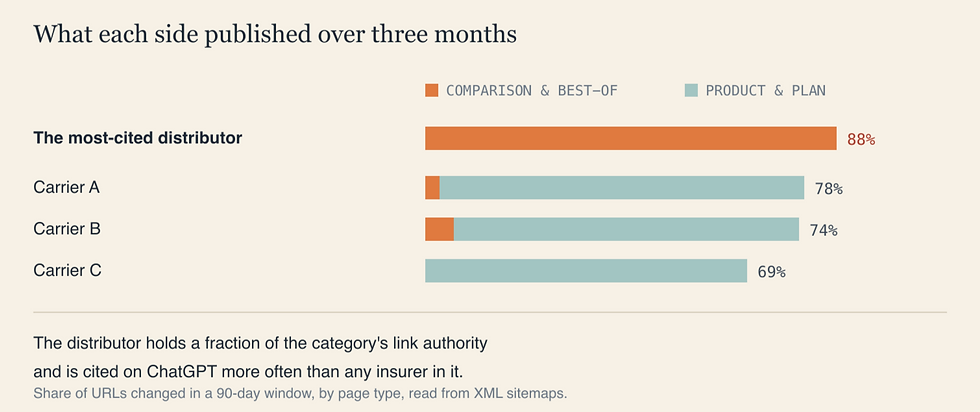
Figure 3. What each side published over three months
Nearly half the health insurance field holds a materially different position on AI answers than on search. A brand ranking top-ten for almost none of these questions is named in 60% of answers; the category's organic leader sits at 24%.
Most insurance marketing teams receive a monthly report describing the first surface. Very few receive anything describing the second. The channel that increasingly delivers a pre-shortlisted buyer is the one nobody is measuring.
It is worth being precise about why the two diverge, because the reason is actionable. Referring domains correlate close to zero with how often AI names a brand in this category. Authority, the thing a decade of SEO investment bought, does not transfer. What does correlate is whether the page is built as an answer to the question the buyer asked.
The economics are different, and better
A buyer arriving from an AI answer arrives pre-shortlisted. They have already been compared, by something the brand did not control, and they are further down the funnel than a click from a results page.
That makes this channel cheaper per conversion than the one it is taking share from, which is the part that should interest distribution rather than marketing. It also makes it winner-takes-most: three names, no second page, and no mechanism to buy your way onto the list.
What we would do about it
Measure it separately. Mention share and recommendation strength are different things and move independently. A brand named often and recommended weakly has a different problem from one that is under-named, and a blended score hides both.
Audit what other people publish about you. If most of the content producing your visibility is not yours, the practical work is knowing what those pages say and correcting them, not producing more of your own.
Publish the comparison. The pages earning citations in this category are structured as answers to specific buyer questions, including questions about named competitors. Very few carriers publish those. Someone is answering "is this insurer any good" at scale, and mostly it is not the insurer.
Insurance distribution has absorbed channel shifts before. What is unusual here is that the channel is not a place you can buy a position in, and its inventory is three names long.
Geology measures and improves how AI engines find, cite and recommend brands. The State of AI Visibility 2026 - BFSI India covers 32 categories of Indian financial services.
Opinions expressed are personal and do not represent the India InsurTech Association.
Key Takeaways
• AI answer engines give insurance buyers two or three names and a reason, instead of a ranked list, a bid-based placement or a page of results.
• In Indian health insurance, the brand that ranks in Google's top ten for 80% of buying questions is named in only 24% of AI answers.
• On ChatGPT, the most-cited company website in the health insurance category is a distributor, not a carrier, cited more often than any insurer and behind only the regulator.
• Nearly nine in ten URLs that the most-cited distributor changed over three months were comparison and best-of pages, while carriers mostly republished product pages.
• One large insurer is named in 60% of AI answers, yet its own website accounts for only 0.8% of the sources behind those answers.
• Across the State of AI Visibility 2026 - BFSI India index, 39% of tracked companies are never named in a single AI answer in their own category.
• Referring domains correlate close to zero with how often AI names a health insurance brand; what correlates is whether a page is built as an answer to the buyer's question.
• Geology recommends three actions: measure AI mention share and recommendation strength separately, audit what other publishers say about the brand, and publish comparison pages.
Frequently Asked Questions
What is the State of AI Visibility 2026 - BFSI India report?
It is Geology's index of what AI answers say about Indian financial services, covering 32 categories. The study asked the questions a buyer asks before deciding on or naming a brand, with no prompt naming a company, and examined which insurers AI engines recommend and what they say about each.
Why does a high Google ranking not guarantee visibility in AI answers for insurers?
The report finds that referring domains correlate close to zero with how often AI names a brand in health insurance, so the authority built through years of SEO investment does not transfer. What does correlate is whether a page is built as an answer to the question the buyer asked. Nearly half the health insurance field holds a materially different position in AI answers than in search.
What should insurance distribution teams do about AI search?
The authors recommend measuring mention share and recommendation strength separately, since they move independently and a blended score hides both. They also advise auditing and correcting what other publishers say about the brand, and publishing comparison pages that answer specific buyer questions, including questions about named competitors.
The opinions expressed within this article are the personal opinions of the author. The facts and opinions appearing in the article do not reflect the views of IIA, and IIA does not assume any responsibility or liability for the same.