


Quality Engineering in the Agentic AI Era: Why Insurance Needs Earned Autonomy, Not Just Smarter AI
Article Summary
This article, contributed by TesQuirel, argues that insurers adopting Agentic AI must stop asking whether an AI agent can perform a task and start asking whether it has earned the autonomy to perform it independently. It shows how AI-accelerated software change has made insurance risk complex and non-linear, using scenarios from underwriting, claims and customer service. It proposes Adaptive Risk Intelligence, a four-stage Earned Autonomy model (Assist, Recommend, Act, Coordinate) and continuous validation in production. Readers gain a practical framework for governing AI agents with human-in-the-loop oversight.
Article by Prasad Jwalapuram, Director, TesQuirel Solutions
Quality Engineering in the Agentic AI Era: Why Insurance Needs Earned Autonomy, Not Just Smarter AI
The insurance industry has always been anchored to a single, non-negotiable asset: TRUST.
Every policy issued, every commercial risk assessed, and every claim settled is a reflection of an organization’s ability to manage risk responsibly. Now, as InsurTechs and traditional carriers embrace Agentic AI to speedup software delivery, we find ourselves at critical crossroads. The engineering challenge is no longer about whether an AI agent can perform a complex task.
The real question we must answer is whether that agent has earned the autonomy to perform it independently without breaking the business.
For Quality Engineering (QE) teams across the ecosystem, this subtle shift changes everything.
1. The Nature of Software Change Has Radically Shifted
For decades, insurance software development relied on predictable, human boundaries. We built mature engineering practices like manual impact analysis, risk-based testing, and structured regression suites. These safety nets worked perfectly because software updates were designed, reviewed by Human Developers and Leads and validated by QA Engineers and Business Users who understood the downstream business rules.
Today, that foundation is shaky. Development teams are heavily using Generative AI to churn out code, APIs and write automated test scripts at an exceptional speed. Simultaneously, business units are deploying autonomous AI agents to interact with policyholders, summarise complex underwriting files, and handle claims.
The sheer speed of these changes has created a massive challenge: software risk has become incredibly complex and non-linear. A tiny, AI-optimized tweak to a shared policy calculation service might look perfectly fine in isolation. However, it can trigger an unpredictable domino effect across premium calculations, rider eligibilities, and statutory regulatory reporting.
Traditional impact analysis frameworks were simply never built to handle software that evolves at the speed of AI.
2. Why Insurance Cannot Afford Unknown Risks
In many consumer tech industries, a software bug may result in a minor user inconvenience. In insurance, the dangers are extremely different. Insurance systems are a complicated web of intensely connected business rules where an error in one component can quietly damage reputation, financial health and regulatory compliance weeks down the line.
Let’s look at three practical scenarios to understand how these hidden risks manifest:
Scenario A: The Underwriting Drift
An AI coding assistant is optimizing underwriting rule engine to make the application load faster. Technically, the code change is clean and easily passes standard unit testing. However, the optimization slightly alters the logic used to classify pre-existing medical conditions for a specific demographic segment. No bugs raised and no error logs are triggered.
Instead, the company begins making inconsistent, high-risk underwriting decisions that go completely unnoticed until claims start spiking months later.
Scenario B: The Claims Automation Blindspot
A carrier introduces an advanced claims processing agent designed to extract information from unstructured documents—like hospital discharge summaries—and automatically recommend settlement pay-outs. Following a core model update, the agent's overall data extraction accuracy jumps significantly. However, the updated model begins interpreting a handful of medical abbreviations differently. It quietly recommends lower pay-outs for a specific subset of claims.
The software works, but the business outcome is flawed.
Scenario C: Unchecked Permission Creep
A customer service AI agent is given the authority to automatically process basic customer address updates. Over time, engineers expand its capabilities, allowing the same agent to modify policy nominee details. While the technical deployment is successful and the agent executes the task flawlessly, it opens a massive governance gap. Should an autonomous agent be allowed to alter legally sensitive nominee information without a human checking the verification documents?
The problem here isn’t capability; it is a lack of operational trust.

3. Expanding Quality Engineering beyond Code
Traditional testing has always focused on a binary question: "Did the software change work correctly?" In the era of Agentic AI, that question is vastly insufficient. QE teams must now expand their scope to look at operational confidence and answer far deeper questions:
Has the AI subtly altered long-standing business behaviours?
Is the customer experience remaining fair and consistent?
Has the overall risk profile of the application shifted?
Can the organization clearly explain and audit every single AI-driven decision?
To be able to answer these questions, we must transition from static Risk-Based Testing to Adaptive Risk Intelligence. Modern quality frameworks need to actively monitor AI-generated code dependencies, agent-to-agent interactions across complex workflows and data retrieval accuracy. Testing must become dynamic and constantly ask:
"What new behaviours could emerge across our ecosystem because of this modification?"
4. The Core Principle: Earned Autonomy
To govern this new paradigm, the insurance sector must embrace the principle of Earned Autonomy.
In any insurance company, human authority is granted progressively. You would never take a new junior claims officer on Day One and give them the authority to sign off settlements. They start with training, shadowing seniors, observing complex cases and assisting on minor tasks. They build a concrete track record of consistency, transparency and sound judgment over time. Only then, they earn the right to sign-off.
AI agents must be held to the exact same standard. An agent shouldn't be granted independent execution rights just because its product demo was impressive. Instead, Responsible AI must follow a structured, evidence-backed maturity journey:
ASSIST → RECOMMEND → ACT → COORDINATE
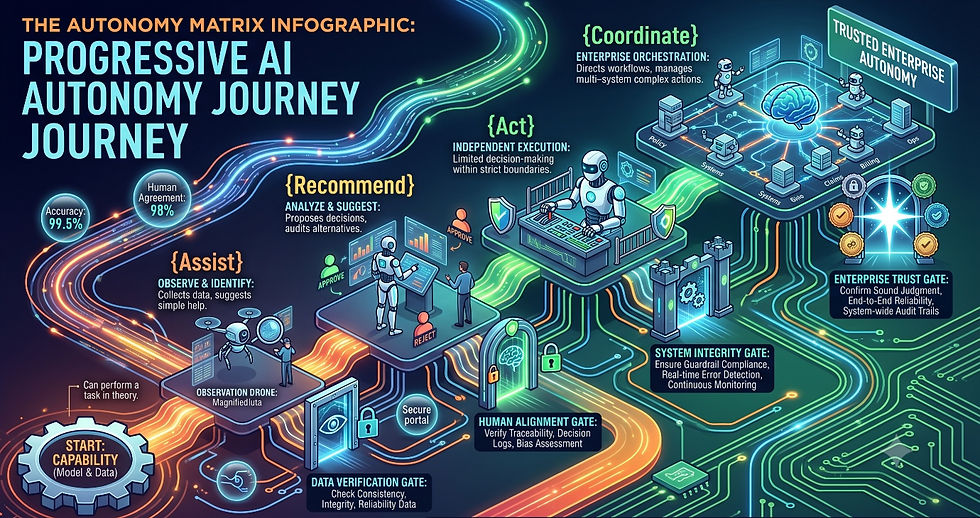
ASSIST: Agent operates in a restricted sandbox, performing low-risk tasks under strict supervision.
RECOMMEND: Agent analyses data and suggests the next course of action, but a human must review and click "approve".
ACT: Agent is permitted to execute decisions independently within restrained and audited operational boundaries.
COORDINATE: Agent safely manages and orchestrates multiple workflows or peer agents across the enterprise, with human in the loop.
5. Continuous Validation is the New Regression Testing
Historically, regression testing was a gateway phase. Teams ran automated tests, ticked off the boxes, approved the production release, and testing cycle is complete.
Agentic AI shatters this old approach. Because models evolve, knowledge repositories are constantly updated, and live data streams shift, an agent that performs perfectly today might drift tomorrow.
Therefore, Quality Assurance can no longer stop at the deployment gates. It must extend straight into production through continuous monitoring of decision quality, customer outcomes, and behavioural patterns. Deployment is no longer the finish line; it is simply a milestone in a continuous loop of verification.
6. Elevating the Human Element
While advanced tools are highly effective at optimizing regression runs and generating test data, technology should not replace human engineering judgment. Final Green Signal should still be in the hands of humans, preferably at each stage, until the Agent “Graduates or Earns” that Qualification. Till then, experienced QA and domain specialists should play the critical role because they ask the deep, rational questions that an AI will completely overlook:
Is this automated underwriting decision genuinely fair?
Does this specific automated claim route conflict with recent regulatory updates?
How will a human claimant feel when receiving this automated response?
The future does not belong to the organizations that act in haste to give their AI systems unearned autonomy. It belongs to the insurers that use AI to increase delivery speed while depending on methodical, human-in-the-loop governance to validate trust.
“Ultimately, the success of Quality Engineering in the modern era will not be measured by how autonomous our technology becomes, but by how thoughtfully that autonomy is earned.”
Key Takeaways
• Trust is the non-negotiable asset of the insurance industry, so Agentic AI adoption must be judged on whether an agent has earned autonomy, not merely on whether it can perform a task.
• Generative AI-driven code, API and test-script generation has made insurance software risk complex and non-linear, which traditional impact analysis frameworks were never built to handle.
• A small AI-optimized change to a shared policy calculation service can cascade into premium calculations, rider eligibilities and statutory regulatory reporting.
• Hidden Agentic AI risks in insurance include underwriting drift, claims automation blindspots and unchecked permission creep, all of which can pass technical testing while producing flawed business outcomes.
• Quality Engineering must move from static Risk-Based Testing to Adaptive Risk Intelligence that monitors AI-generated code dependencies, agent-to-agent interactions and data retrieval accuracy.
• The Earned Autonomy model moves AI agents through four stages (Assist, Recommend, Act and Coordinate), mirroring how insurers grant authority to human staff progressively.
• Continuous validation in production replaces gateway regression testing, because evolving models, updated knowledge repositories and shifting live data can make an agent drift after deployment.
• Experienced QA and domain specialists should hold the final green signal until an AI agent earns that qualification, asking fairness, regulatory and customer-impact questions that AI may overlook.
Frequently Asked Questions
What is Earned Autonomy in the context of Agentic AI in insurance?
Earned Autonomy is the principle that AI agents should be granted independent execution rights progressively, the same way insurers grant authority to human staff such as a new junior claims officer. Instead of being trusted because of an impressive product demo, an agent follows a structured, evidence-backed maturity journey through four stages: Assist, Recommend, Act and Coordinate.
Why is traditional regression testing insufficient for Agentic AI systems?
Traditional regression testing was a gateway phase that ended once a production release was approved. With Agentic AI, models evolve, knowledge repositories are constantly updated and live data streams shift, so an agent that performs perfectly today might drift tomorrow. Quality Assurance must therefore extend into production through continuous monitoring of decision quality, customer outcomes and behavioural patterns.
What role should humans play as insurers adopt AI agents?
The article argues that technology should not replace human engineering judgment, and that the final green signal should stay with humans until an agent earns that qualification. Experienced QA and domain specialists ask questions AI may overlook, such as whether an automated underwriting decision is fair, whether a claim route conflicts with recent regulatory updates, and how a claimant will feel about an automated response.
The opinions expressed within this article are the personal opinions of the author. The facts and opinions appearing in the article do not reflect the views of IIA, and IIA does not assume any responsibility or liability for the same.


